28.8.10

Week 5- Tutespark

The first Culture Jam

The term "cultural jamming" was first used by the collage band Negativland to describe billboard alteration and other forms of media sabotage. On Jamcon '84, a mock-serious bandmember observes, "As awareness of how the media environment we occupy affects and directs our inner life grows, some resist...The skillfully reworked billboard...directs the public viewer to a consideration of the original corporate strategy. The studio for the cultural jammer is the world at large." http://www.rebelart.net/source/dery.pdf


The most influential Culture Jam
The most influential culture jam is the 2004 American documentary "Super Size Me" directed by and staring Morgan Spurlock. The film follows a 28 day period which he only eats McDonalds for every meal, demonstrating poor nutrition as he always "super sizes" his meals.

File-Super_Size_Me_Poster.jpg


http://en.wikipedia.org/wiki/Super_Size_Me


The most damaging Culture Jam

At a first glance Nike's latest billboard, "The most offensive boots we've ever made," uses a simple word play to confuse the notion of offensive. Offensiveness is a football tactic, they tell us, not a response to injustice. This created fictional sense of 'offense' crowds out any notion of real moral offense. The passive spectator of the ad, the one who doesn't consciously notice the billboard and couldn't be bothered thinking about it, has their notion of 'offense' blurred and slightly confused. It's far easier to think sport than to think about the complexities of human rights abuses in other countries. The powerful cultural voice of Nike is telling me that offense has to do with sport, and I don't like getting into arguments.


source: anon

Not content with the normal boundaries of advertising, Nike's publicity takes it further. They build upon this fictional offense by 'jamming' their own billboards. They paste over their own billboards (though conspicuously never covering over the Nike swoosh) with messages, "What next, rocket packs?," and "Fair Minded Footy Fans say Not Fair Mr Technology" in order to feign outrage at the supposed injustice of boots that are simply too good. These 'jams' even go as far as to mimic the messy typefont used by previous authentic jams.

http://www.antimedia.net/nikesweatshop/


Week 5- Response to Lecture

In last weeks lecture, we spoke about the consumption of film and television, and the significant dates in history that changed the industry. This week's lecture picked up where we left off, introducing the other side of film and television; production. With such amazing technical devices being made nowadays, such as high quality digital cameras, laptops and mobile phones with cameras/video cameras, any regular person is able to produce their own film in the palm of their hands.

These inventions give everyday people the opportunity to show their creativity, and with online video streaming websites such as youtube, they are able to showcase their works on the internet to the entire world, hoping that one day someone will see it and believe they have talent. The convergence between consumption and production is made possible through modern devices, making film production simple, affordable, accessible and easy to do.

In the lecture, Jules explained to us that the first footage of the Tsunami was released via a mobile phone. Due to the severity of the waves, the media were unable to get in there to document the horrific natural disaster. Without mobile phones, the world would have never been able to experience this tragedy.

Here is an example of a simple short film called "Midnight Paranoia", filmed and edited on a Nokia 6220:


We also briefly spoke about Culture Jamming which is defined as a method of modifying mass media to convey a "message" whether it's political, social or some other form of activism. Although I had never heard of this term before, I had heard of stories which have portrayed culture jamming. I believe the approach of culture jamming has positives and negatives; the false stories created have a message which may or may not effect people around the world, however, these false stories created can hurt people as they are led to believe false information.

24.8.10

Week 4- Response to Lecture

In this week's lecture, we discussed movies and television- "from the big screen to the small". Over time, the cinema industry and the television industry have fought for the top spot; the one with the highest ratings and the one who makes the most money. However, today they have gradually worked together to combine a solution that not only brings money in for both sides, but entertains viewers.

In 1895, Cinema was born in Paris and two years later the first permanent movie theatre was built. 1903 saw the birth of the first narrative film which was only 14 scenes and 10 minutes long (clearly, we have come a long way since then). Three years later, the first full length feature film was made in Australia, "The Kelly Gang", which went for 60-70 minutes. With the creation of sound in 1921 and technicolour in 1923, the cinema industry was developing into a spectacular medium which could be enjoyed by people of all ages. The cinema industry has progressed even further nowadays with the invention of imax theatres, 3d movies, and blockbusters.

1939 saw the birth of television television which is when the war began between tv and film. The cinema industry now had to create new and more exciting forms of viewing cinema in order to keep society entertained. However, in 1955, the cinema and television industry combined to show movies on tv which therefore brought money in for both sides. With modern inventions such as DVDs, 3d tv's, austar and high definition, both industries continue to find more ways to make money with the assistance of technology. And as technology continues to advance, so will the movie and television industries keeping the cycle of money spinning.

17.8.10

Week 4- Tutespark

"Coin Laundry" by Jerome Olivier
Coin Laundry is a short story about a man who has a very simple idea about how to lead a happy life. He would love to share his life with someone else, but no one wants to listen because they perceive him as a wacko who walks around with a laundry basket, until he finds his sole mate in the end. Director, writer and producer, Jerome Olivier, says that "Coin Laundry was designed for web viewing from the ground up" and newvenue.com was a great place to stream it as it is an exhibition space made for films that are specifically made for the internet.

The simple storyline makes this short film quite effective. It is a nice love story which viewers of all ages can enjoy. Im not sure if this film could ever become viral because it is probably not very appealing to most people, for example, young boys and is a tad unrealistic. However, it is a pleasant short film conveying a simple love story between two young people.

http://www.newvenue.com/archives/feature49/index.html

"Lovefield" by Mathieu Ratthe
Mathieu Ratthe is an aspiring director who streams his work via youtube. His short film, "Lovefield" creates a variety of emotions within the hearts of viewers they are taken on a short emotional roller coster. The short film sees a man standing in the cornfield leading the audience to believe he has murdered a woman. With blood all over him, he goes to his car acting very suspicious and ancy, until we finally see a baby who is born and the viewers realise he has helped deliver it.

I like that the storyline is unexpected and suspenseful. It creates a number of different moods and emotions within the viewer. The quality and effectiveness of the filming really makes the film so awesome. The variety of angles and shot techniques enhance these emotions conveyed and make it very appealing to a wide audience.


"Pixels" by Patrick Jean
Pixels is an extremely clever short film about old video games such as tetris, pacman, donkey kong, etc, taking over the world and creating havoc in New York. Patrick Jean is a graphic designer who came up with the concept and made it along with One More Production and streamed it on the internet. Within 24 hours of its release the film had gone viral with the concept now about to be made into a film by Adam Sandler.

Pixels is such a cool concept and so cleverly put together which is no wonder why it went viral so quickly. Although the storyline is unrealistic, it captures the idea of fantasy and possibility and really creates that "what if" factor within viewers.


Please note: Week 4 Tute Task is under Week 3 response to lecture

Week 3- Response to Lecture & Tutespark

This week's lecture focused on a short history of the computer and the internet. The computer had origins in various machines, including Charles Babbage's Difference Engine created in the 19th century. The computer became a commercial product in the 1950s and the first computer was sold, used solely for government, military and corporate companies, however it was still large and unsuitable for average home consumption. However, the first computer was founded by Alan Turing during WW2, and in 1975 the first PC (personal computer) was released by Bill Gates called Microsoft.

It is interesting to know that the computer was originally mechanical rather than electronic, and the first computer program was created by Ada Byron- Lady Lovelace. The 1990s saw the birth of the World Wide Web (WWW) allowing us to use computers and the internet to communicate. Certain internet applications were created as communication tools including electronic mail (email), file transfer protocol (FTP) and internet relay chat (IRC). Nowadays, there are even more internet communication tools which attract a faster response and are even more reliable. These include instant messaging (IM), peer-2-peer file transferring (p2p), portable audio, voice chat (eg. Skype), Facebook, Myspace and Twitter.

Technology continues to advance day by day, through new inventions, discoveries and developments in science. The world will forever be introduced to new and exciting communication tools which will assist us in our everyday living. The World Wide Web is all around us and has become an essential part of society and I don't believe we would know how to live without it.

TUTESPARK
Digital- a data technology that uses discrete (discontinuous) values...Although digital representations are discrete, the information represented can be either discrete, such as numbers, letters, or icons, or continuous, such as sounds, images, and other measurements of continuous systems.- http://en.wikipedia.org/wiki/Digital

Analogue- A method to store information as continuously variable signals instead of electronic codes.- http://publications.europa.eu/vademecum/vademecum/9313fdfe-c49e-119e-45c6a6441e63e066_en.html

Communication- Communication is a process of transferring information from one entity to another. Communication processes are sign-mediated interactions between at least two agents which share a repertoire of signs and semiotic rules.- http://www.google.com.au/search?client=safari&rls=en&q=define:communication&ie=UTF-8&oe=UTF-8&redir_esc=&ei=D_N5TOm4IsWPcdqX2PQF

Electronic- the branch of physics that deals with the emission and effects of electrons and with the use of electronic devices- http://wordnetweb.princeton.edu/perl/webwn?s=electronics

The Typewriter-
is a mechanical device containing a set of keys and when they keys are pressed, characters are printed onto paper.

typewriter.jpg

http://www.principalspage.com/theblog/wp-content/uploads//2007/07/typewriter.jpg


Cassette Tape-
is a magnetic tape sound recording format...consisting of two miniature spools, between which a magnetically coated plastic tape is passed and wound. These spools and their attendant parts are held inside a protective plastic shell. Two stereo pairs of tracks (four total) or two monaural audio tracks are available on the tape; one stereo pair or one monophonic track is played or recorded when the tape is moving in one direction and the second pair when moving in the other direction. This reversal is achieved either by manually flipping the cassette or by having the machine itself change the direction of tape movement ("auto-reverse").
http://en.wikipedia.org/wiki/Compact_Cassette

cassette-tape-1.jpg

http://www.davidairey.com/images/design/cassette-tape-1.jpg


Braille-
is a method used by blind people to read and write. Named after Louis Braille, who created it in 1821, each character is made up of six dot positions arranged in 2 columns of 3 dots each.

Braille.gif

http://www.quido.cz/objevy/Braille.gif

Week 4- Tutorial Task

1.Where and when did usable online video start?
FireAnt.tv was the first RRS based media player created for downloading and viewing online videos

2.In the lecture we heard about technological innovations that were used by the studios to lure audiences. What recent innovations are being used to lure us in the movies? What are they luring us from?
Nowadays, the film industry is beginning to create a lot of 3D movies, creating an exciting experience for audiences- eg. get to wear cool glasses, the action pops out right in front of your face. Although 3D is an older medium and has been around since 1952, majority of movies being created these days are coming out in 3D as well as 2D. Also, a popular genre at the moment is romantic-action movies which combines the two most popular genres into one which invites a wider audience eg. both sexes. These innovations are luring us away from our own home entertainment systems, eg. austar, surround sound, dvd players, higher quality televisions, and back into the cinema for a more social viewing.


3.Are short films still being made? Why? Who pays for them to be made?
Yes, short films are still being made. For example, advertisers are creating short films in order to advertise their products, hoping to make a positive influence on viewers and also independent and emerging film makers, trying to be recognised and show their talent and passion. In addition, well-reknowned animation company Pixar still create short films and have been since 1986 and their website claims that "Pixar's shorts have helped foster and develop technologies and talent at the studio, but they are mostly made for one simple reason: love of the art form" (http://www.pixar.com/companyinfo/about_us/overview.htm). Pixar has picked up nine Academy Awards nominations and three Academy Awards over time. Their latest short released was Toy Story 3 which is currently screening in cinemas.

4.The term viral is thrown about adhoc but what does it mean in film/movie arena? Give some examples.
The term viral relates to a video spread by "word of mouth" on the internet because of it's "infectious" nature. Some example include "Bon Qui Qui", William Hung's American Idol audition tape, and also Lazy Sunday: The Chronicals of Narnia Rap by The Lonely Island. Generally, this infectious nature of the viral videos is the humour factor that each possess. Young kids, especially, come across these funny videos online and tell their friends, who tell friends who tell friends of friends, and therefore the cycle begins and soon enough, the video becomes viral.

5. Online video distribution isn't limited to the short film format. We are now starting to see television styled shows made solely for internet release (webisodes). Find an example of this style of content and discuss how viewing television content in this way can positively and negatively affect the viewer's experience.
Webisodes.org is an online video distribution site which release videos in "webisodes". Many television shows these days are being aired not only on the television but also on various video streaming websites- eg. casttv.com and surfthechannel.com. Viewing video online has some positives and negatives effects on the viewer's experience- online video is easily accessible and always available and with modern day technology, such as laptops, iphones and ipods, is extremely portal. The down side is that the viewing of online video is generally personal nowadays and usually takes place at home, taking viewer's away from the social factor of seeing a movie with others and keeping them locked up in the house instead of getting out and going somewhere.


10.8.10

Week 3- Tutorial Task

Treasure Hunt

1. What is the weight of the world’s biggest machine? How much did it cost to build?
Bagger 288- 45,500 tonnes and costed $100 million to build

http://www.michaelgriswold.com/Pictures/ALL/bagger/bagger.html (13/8/10)

2. What is the best way (quickest, most reliable) to contact Ozzy Osborne?

The quickest way to contact Ozzy Osbourne would be by Twitter

http://twitter.com/OfficialOzzy (13/8/10)


3.When and what was the first example of global digital communication?

The first example of global digital communication was Morse Code invented by Samuel F. B Morse in 1836.

http://www.omniglot.com/writing/morsecode.htm (16/08/10)


4. What is the cheapest form of travel from the Gold Coast to Melbourne?

The cheapest form of travel from Gold Coast to Melbourne is flying with Tiger Airways for $59 with no luggage


http://travel.webjet.com.au/webjettsa/home.aspx?flight_search_action=http%3A%2F%2Ftravel.webjet.com.au%2Fwebjettsa%2Fhome.aspx&TripType=OneWay&CityFrom=OOL&DateOut=2010%2F8%2F18&CityTo=Melbourne&DateBack=2010%2F8%2F22&TravelClass=ECONOMY&NumAdult=1&NumChild=0&NumInfant=0&x=55&y=13&EntryPoint=Flight&RequestFrom=Outside

(14/8/10)


5. Who is Hatsune Miku? What company does she belong to? What is her birthday?

Hatsune Miku is the vocaloid2 which is a singing synthesizer software created by Yamaha Corporation, allowing users to synthesise singing bytyping in lyrics and melody. Her birthday is the 31st of August


http://www.moetron.com/2008/08/30/happy-birthday-to-our-sweet-virtual-idol-hatsune-miku/


http://answers.yahoo.com/question/index?qid=20080816221211AAkCD73 (14/8/10)


6. Find a live webcam in Antarctica. Find a place to stay in Antarctica.

The live webcam that I found from Antarctica was from Mawson Station which is an isolated outcrop of rock at the edge of the Antarctic highland. Additionally, at Mawson Station you can stay in a living hut called the Balleny which can provide accomodation for up to six people.


http://www.aad.gov.au/asset/webcams/mawson/default.asp

http://www.virtualtourist.com/hotels/Antarctica/Hotels_and_Accommodations-Antarctica-TG-C-1.html (16/08/10)


7. What song was top of the Australian pop charts this week in 1980?

The top song was ACDC's "You shook me all night long"

http://www.answers.com/topic/back-in-black (16/08/10)


8. How would you define the term 'nano technology'? In your own words, what does it really mean?

Nano technology is the manufacture of a small structure measured in nano metres and created from elements such as atoms and molecules.


http://www.ask.com/wiki/Nanotechnology (16/08/10)


9. What type of camera is used to make ‘Google Street View’?

The type of camera used was the Dodeca 2360 made by Navteg


http://www.itechdiary.com/camera-to-make-street-view-technology-in-google-map.html (16/08/10)


10. Translate these questions into Klingon


1. nuq 'oH the weight vo' the world’s biggest machine chay' 'ar ta'ta' 'oH cost Daq chen


2. nuq 'oH the best way quickest HochHom reliable Daq contact Ozzy Osborne


3. ghorgh 'ej nuq ghaHta' the wa'DIch example vo' global digital communication


4. nuq 'oH the cheapest form vo' travel vo' the SuD baS Coast Daq Melbourne


5. 'Iv 'oH Hatsune Miku nuq company ta'taH ghaH belong Daq nuq 'oH Daj qoS


6. tu' a yIn webcam Daq Antarctica tu' a Daq Daq stay Daq Antarctica


7. nuq bom ghaHta' top vo' the Australian pop charts vam week Daq


8. chay' would SoH define the term nanotechnology Daq lIj ghaj mu'mey nuq ta'taH 'oH really mean


9. nuq type vo' camera 'oH used Daq chenmoH Google Street View


10. [Translate] Dochvammey [questions] Daq tlhIngan


http://www.mrklingon.org/


Week 2- Extra Task

Although there are many different types of shot sizes, each demonstrating something different, there are also different techniques, angles and movements that can be used to create an effective shot and every medium utilises them in various way to portray various things. These include camera techniques such as panning, zoom, tilt, crab, tracking, etc which each assist the shot in various ways whether its revealing more of the scene, following a moving subject, the camera moving right to left, or to show a more intense relationship between actors. There are also many editing techniques such as cutting and fading, manipulating time techniques such as freeze frame or flash forward/back, use of sound, lighting, graphics, formats and narrative style, all which are used in their own unique way to create an original film or television show.

Week 2- Response to Lecture

In this week's lecture, we spoke about "Cine-speak" which covers a broad range of topics including shot sizes, shots as words, head room, talking room, the rule of thirds and 180 degree rule. There are various types of shot sizes, each slightly varying from one another. These include: a very long shot/wide shot, long shot, medium shot, mid shot, medium close up, close up, big close up and extreme close up. Although these shot sizes just sound like fancy words for different shot lengths, they are cleverly utilised to portray different emotions, actions and progressions of time throughout a film or television show. Therefore, we are able to think of shots as words; who, what, when, where, why and how-


WHO- close up shows character in detail and portrays emotion
WHAT- mid shot displays the subject performing an action
WHERE- long shot establishes where the action takes place eg. sets the scene
WHEN- wide shot and close up can help show time progressing or the time of day yet can sometimes be hard to capture on camera
WHY- big close up can answer the 'why' question usually by revealing more about t he character and actions
HOW- medium close up or series of close ups can show progression of the film and/or story line

By thinking of shots as words and utilising them in this way, the audience is able to understand the story line of the film or television show by clearly being able to see the emotion and action occurring. This method is useful for directors and producers because they are easily able to think about how they are going to portray a certain action or emotion to the audience through the use of their cameras and by knowing which shot sizes demonstrate which action or emotion, they are able to creatively work with that shot size.

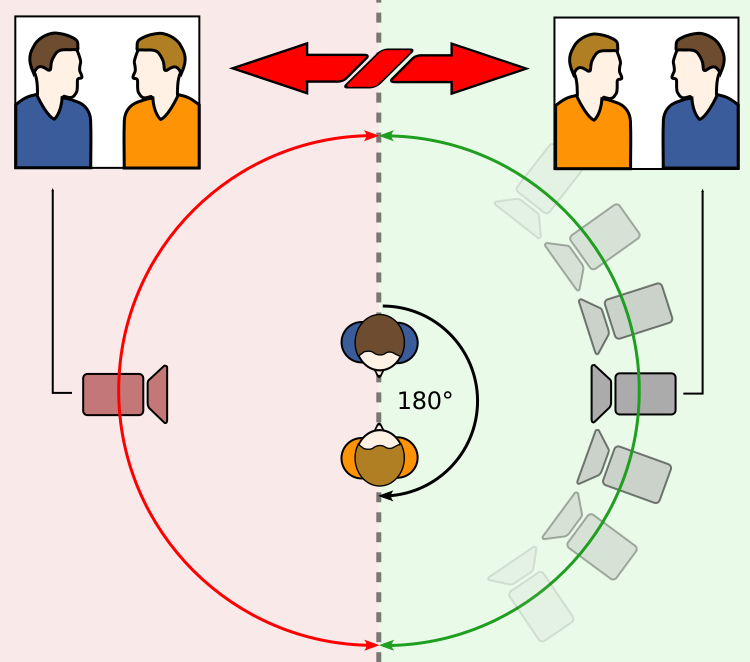
Although there are various shot sizes, there is also four important rules which each shot must include: head room, talking room, the rule of thirds and the 180 degree rule. Head room must be consistent throughout each shot in regards to how much space is in the shot for the actor's head. If the head room is not consistent it can make the actor look larger or smaller than they really are which would look bazaar if they kept changing heights. Talking room on the other hand is the amount of room in the shot that the actor is given to talk into. It is vital that there is an even amount for the actor to talk into unless being used for emphasis eg. a screaming fight between two actors may have very minimal talking room to portray them yelling in each other's faces. With the rule of thirds you must avoid placing the subject in the centre of the frame, as it must be split into three sections in the shot which have intersection points both vertical and horizontal. When filming someone, it is common that the camera man will line up the subjects body with a vertical line. The 180 degree rule refers to dialogue in a shot as two characters should always have the same left/right relationship with each other. This can also be known as 'crossing the line', meaning if the camera crosses the imaginary axis it will create a reverse angle. 180_degree_rule.svg


Week 2- Tutorial Task