WHO- close up shows character in detail and portrays emotion
WHAT- mid shot displays the subject performing an action
WHERE- long shot establishes where the action takes place eg. sets the scene
WHEN- wide shot and close up can help show time progressing or the time of day yet can sometimes be hard to capture on camera
WHY- big close up can answer the 'why' question usually by revealing more about t he character and actions
HOW- medium close up or series of close ups can show progression of the film and/or story line
By thinking of shots as words and utilising them in this way, the audience is able to understand the story line of the film or television show by clearly being able to see the emotion and action occurring. This method is useful for directors and producers because they are easily able to think about how they are going to portray a certain action or emotion to the audience through the use of their cameras and by knowing which shot sizes demonstrate which action or emotion, they are able to creatively work with that shot size.
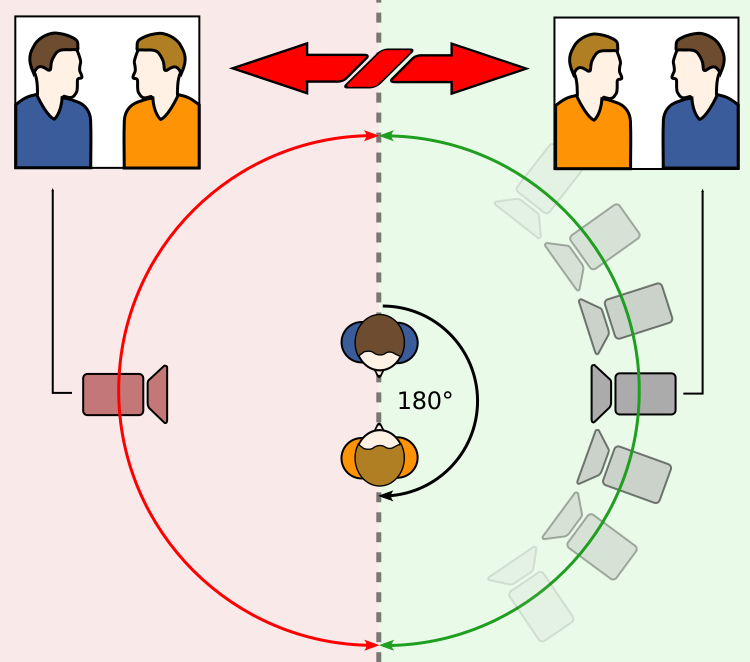
Although there are various shot sizes, there is also four important rules which each shot must include: head room, talking room, the rule of thirds and the 180 degree rule. Head room must be consistent throughout each shot in regards to how much space is in the shot for the actor's head. If the head room is not consistent it can make the actor look larger or smaller than they really are which would look bazaar if they kept changing heights. Talking room on the other hand is the amount of room in the shot that the actor is given to talk into. It is vital that there is an even amount for the actor to talk into unless being used for emphasis eg. a screaming fight between two actors may have very minimal talking room to portray them yelling in each other's faces. With the rule of thirds you must avoid placing the subject in the centre of the frame, as it must be split into three sections in the shot which have intersection points both vertical and horizontal. When filming someone, it is common that the camera man will line up the subjects body with a vertical line. The 180 degree rule refers to dialogue in a shot as two characters should always have the same left/right relationship with each other. This can also be known as 'crossing the line', meaning if the camera crosses the imaginary axis it will create a reverse angle. 180_degree_rule.svg

No comments:
Post a Comment